Unpaid Work
A quick search gave me this answer, so I quote – “Domestic labour refers to the unpaid work done within households, encompassing tasks like housework, childcare, and other forms of care work.”
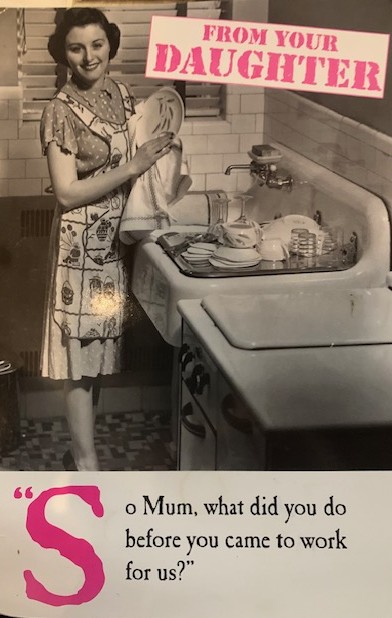
The key is that it is unpaid work and 56 years after I joined the 1970 Women’s Movement it is still mostly women’s work. I quote again – “Without this type of labour people (humans) would not be able to survive both as individuals, and as society.”
What is domestic labour, who does it and who needs it?
The fact is that human life depends on “Domestic Labour” that is unpaid and mostly women’s work. I will emphasise that this means family life, household hygiene, food preparation, care of babies, children, the sick, the disabled and the elderly. All these various stages of our lives are dependent on some degree of unpaid domestic labour and care.
Low Status Stigmatised Work
Here is the problem about Domestic Labour. It has low status and there is a surprising amount of bigotry around it. It is a curious fact that even PAID Domestic Labour carries a stigma. The reason for this is that it is often very intimate work conducted in a personal space that has to do with “dirty laundry”, waste rubbish, and cleaning places where people shit. One key question is whether the low status is because it is women’s work or because it is about hygiene? Mary Douglas wrote about hygiene and pollution in her book Purity and Danger. These areas of human life are guarded by culture, social traditions and religious beliefs and that may explain why attitudes are slow to shift. These jobs are a good and essential service to humanity but if the people who do them are called “servants” what does that mean for their work?
Servants and Service
The Google dictionary says a servant is a person who performs duties for others, especially a person employed in a house on domestic duties or as a personal attendant. A member of Parliament, a priest, a government official are all servants in employment, but the question becomes fraught when a wife is expected to serve her husband. Where are her boundaries and does he arrange them to a macho plan ordained by some god or other? Are servants the lowest part of a class system? Isabel Colegate’s The Shooting Party and Kazuo Ishigura’s The Remains of the Day depict a changing class system where the essential “servants”, butlers, cooks and housekeepers, employed and paid by the “upper class”, are very skilled, knowledgeable and hard-working.
Other Cultures and Slavery
Does that mean that other ethnicities and other social classes don’t need domestic labour and so do not survive? That of course would be nonsense. All humans need domestic labour. The poorer the people are who provide care and domestic labour the more they will be exploited. The poorer people who need domestic help are, the more exploitative they may be. The most extreme exploitation is slavery and indentured work which has existed as long as humans have needed help and enforced it. Consider the way domestic labour was shared out in villages, families and small communities. Consider that one of the reasons men (and their senior wives) wanted more than one wife was because there was more work than was manageable by one wife with babies. (Read Lucy Mushita’s novel Chinongwa.)
Traditional Attitudes
The traditional working class also depended on Domestic Labour, but this was often unpaid, kept within the family and done by grandmothers, spinster aunts, daughters not in education, and the wife. Today Domestic Labour is provided by machines that wash, cook and vacuum floors for us. We are promised robots in the future to care for us in old age. Our shopping is done online and delivered by Amazon. We eat Fast Food and Readymade Meals but before we sneer at people who employ domestic labourers at low rates, we should remember the people who work at low rates for Amazon, Food Factories, Industrial Farms, Fast Food Outlets as well as the couriers on cycles who deliver the orders. These are people you use to serve you! Above all consider the workers in hospitals and care homes. How many of these people are illegal and underpaid migrants? If you think you have never needed domestic labour, you may just have outsourced it and have no children or dependent old folk to care for.
Intimate Domestic Work
Domestic labour and its pay keep changing as do those who provide it. My own life is a good example of this. I grew up in colonial Africa and my family kept servants. The kitchen cooks, however, were men though child carers (nannies) were still women. I shan’t deal with this gender reversal here. As a left-wing, anti-apartheid believer in equality, I chose to live in independent Africa but I still needed help in the house as I had a job, children, and a husband whose work required my input, my support and work with his staff and patients. The power dynamics of the intimate servant/employer relationship is fraught with problems to do with social change, race, class, education and gender. My staff however, were a benefit paid for by my husband’s employer so I treated them as staff not servants and saw they worked an 8-hour day with extra pay for baby-sitting or extra hours worked. They had a house with a bathroom and a cooking area, my husband provided health and I provided some schooling for the children. I did the cooking for my own family. My house staff were treated in the same way as I treated the staff in the art gallery I ran.
Domestic Work and the Sex Role
The new Zambian bourgeoisie have some of the same problems in these relationships as their colonial predecessors. British women worry that their au pair might be seduced by their husband. Zambian women worry that their female servant might replace them in their husband’s bed.
An interesting anthropology book by Karen Transberg Hansen called Distant Companions explores these relationships in Zambia between 1900 and 1985.